


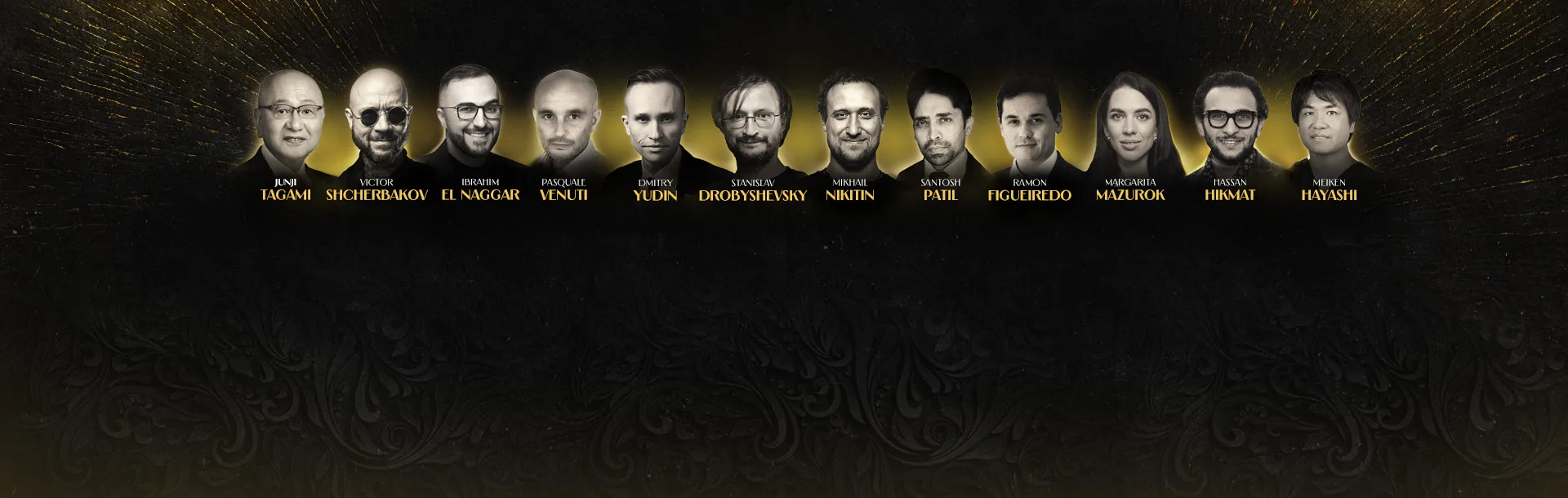
DENTAL FUSION 2.0 Cutting-edge Science — AI — Technologies A CONGRESS that will TRANSFORM your clinical THINKING. The brightest minds in modern dentistry, leading global scientists, and top-tier clinicians:
- Junji TAGAMI — The Foundations of Adhesive Dentistry from the Father of Adhesive Dentistry.
- Pasquale VENUTI — Restoration Biomechanics and Crack Development.
- Viktor SCHERBAKOV — Crystallography of Dental Tissues and the Restoration of Discolored Teeth.
- Santosh PATIL — Laser Technologies: Principles, Clinical Strategies, and Applications.
- Dmitry YUDIN — Pain in Dentistry, Neurology, and the Limits of TMJ Adaptation.
- Hassan HIKMAT — Functional Proximal Contacts: The Art of Precision.
- Meiken HAYASHI — Flowable Composites: A New Era in Restorative Dentistry.
- Ibrahim EL NAGGAR — Complex Endodontics and Tooth Preservation.
- Ramon FIGUEIREDO — Composite Veneers: The Details That Make the Difference.
- Margarita MAZUROK — Reattachment After Dental Trauma: Biology and Clinical Protocols.
- Stanislav DROBYSHEVSKY — The Evolution of the Human Dentofacial System.
- Mikhail NIKITIN — Human Adaptation to Food: The Biology of the Oral Cavity.
A signature event by the most progressive educational brand in Russia and worldwide — ZenCourses — and by Viktor Scherbakov, who will moderate the congress and ensure that each speaker is fully revealed to the audience. A concept built around deep, rich lectures that thoroughly explore each topic. As always tasteful, conceptual, musical, and irresistibly stylish!
Participation Fee
STANDARD PACKAGE (registration and payment):
— Until January 31: 730$ +5% VAT — Until August 30: 855$ +5% VAT — From September 1: 1200$ +5% VAT
PREMIUM PACKAGE (registration and payment):
— Until January 31: 920$ +5% VAT — Until August 30: 1200$ +5% VAT — From September 1: 1320$ +5% VAT Prepayment: 190$ Group and corporate discounts are available upon request — please contact our manager for details. What’s included?
STANDARD PACKAGE
- Attendance at the two-day congress
- Coffee breaks and lunches
- Special ZenCourses certificate
PREMIUM PACKAGE
- Separate registration desk
- Priority seating in the front rows
- Coffee breaks, lunches, and AfterParty on Day 2
- Full congress video recording (2-month access)
- Gifts from sponsors
- Exclusive badge design
- Branded commemorative T-shirt
- Special ZenCourses certificate
Hassan Hikmat – internationally recognized expert in direct restorative dentistry and functional proximal anatomy, Silver Member of StyleItaliano, founder of the International Restorative Symposium (I.R.S.), and one of the leading lecturers in the Middle East.
Lecture Topic:
"The Contact Point: The Art of Precision in Reproducing Natural Proximal Anatomy of Posterior Teeth."
Restoration of the proximal surfaces of posterior teeth is one of the most common procedures in everyday clinical practice. Nevertheless, achieving predictable proximal anatomy, an optimal contact point, and the correct restoration contour remains a significant challenge due to the wide variety of available techniques and clinical approaches.
In this lecture, Dr. Hikmat will present a practical approach to posterior proximal restorations based on the principles of natural tooth anatomy. Participants will learn how to analyze each clinical situation, plan restorations systematically, and reproduce natural proximal anatomy using standardized clinical protocols. Special emphasis will be placed on creating healthy, functional, and long-lasting proximal surfaces that promote periodontal health while maintaining resistance to occlusal and chemical stresses over time.
Junji Tagami – one of the world's leading experts in biomaterials and adhesive dentistry, author of hundreds of scientific publications that have laid the foundation for modern restorative dentistry.
Lecture Topic:
"Biological and Technological Principles of Minimally Invasive Adhesive Esthetic Restorations."
Professor Junji Tagami explores the biological foundations of adhesion, including the structure of enamel and dentin, moisture dynamics, collagen architecture, and hybrid layer formation, demonstrating how these principles shape minimally invasive esthetic restorative protocols.
The lecture integrates the fundamental biology of dental tissues with contemporary adhesive technologies, covering etching strategies, adhesive selection, and modern polymerization techniques. Professor Tagami demonstrates how advances in biomaterials and adhesion research enable clinicians to perform esthetic restorations that are highly conservative, predictable, and long-lasting.
Coffee Break
Pasquale Venuti – world-renowned expert in the biomechanics of restorative dentistry and one of the pioneers of the vertical preparation concept.
Lecture Topic:
"Restoration Biomechanics, Crack Development Mechanisms, and the Rehabilitation of Severely Compromised Teeth."
Preserving severely compromised teeth requires deeper knowledge, greater clinical expertise, and a significantly steeper learning curve than placing and restoring a dental implant. In an aging population, tooth preservation is not only an ethical choice but also a more rational and sustainable solution from both biological and economic perspectives.
The first part of the lecture focuses on the fundamental, yet often overlooked, principles of static and kinematic mechanics of the tooth-restoration complex, which serve as the foundation for sound treatment planning.
The second part presents clinical strategies for restoring severely compromised teeth and maximizing the longevity of the tooth-restoration complex. Topics include matrix-free peripheral build-ups, vertical preparation, customized metal posts, and orthodontic extrusion.
Lunch
Dmitry Yudin – Candidate of Medical Sciences, leading expert in maxillofacial and reconstructive surgery, head and neck pathology, and oral oncology.
Lecture Topic:
"When the Patient Fails to Adapt – Pain, Digital Dentistry, and the Limits of Clinical Care."
Chronic pain, patient dissatisfaction, and "unfinished cases" are often not the result of treatment errors, but rather a consequence of the patient's inability to adapt to clinical changes. This lecture explores the signs of maladaptation, atypical pain syndromes, and the role of digital and neurophysiological technologies in shortening the patient's path to rehabilitation. Special emphasis will be placed on clinical decision-making, effective communication, and knowing how to conclude treatment appropriately without worsening the patient's condition.
During this comprehensive lecture, Dr. Dmitry Yudin will cover:
- Atypical facial and orofacial pain in dentistry.
- Patient maladaptation to a new occlusion, an altered vertical dimension of occlusion, and esthetic or functional changes.
- Psychoneurological factors that interfere with rehabilitation or mimic dental pathology.
- Common errors in treatment planning and patient communication:
- how to identify patients who require a different therapeutic approach, shorten the rehabilitation pathway,
- prevent the development of chronic pain, and, most importantly, successfully complete a clinical case rather than simply referring the patient elsewhere.
- The use of digital technologies and electroencephalography (EEG) in modern dentistry.
- The relationship between pain, esthetics, and function through the mechanisms of patient adaptation.
Stanislav Drobyshevsky – world-renowned anthropologist, Associate Professor at the Department of Anthropology, Lomonosov Moscow State University, and one of Russia's leading science communicators.
Lecture Topic:
"The Evolution of the Human Dentofacial System."
This lecture explores the long evolutionary journey of the human dentofacial system – from the earliest hominin primates to modern Homo sapiens. Dr. Stanislav Drobyshevsky explains how changes in diet, lifestyle, tool use, thermal processing of food, and even cultural evolution have gradually shaped tooth morphology, jaw strength, occlusion, root anatomy, and the development of oral tissues.
Drawing on evidence from anthropology, paleontology, comparative anatomy, and evolutionary biology, Dr. Drobyshevsky, together with Dr. Viktor Scherbakov, will uncover the evolutionary origins of many common dental conditions, including tooth crowding, various malocclusions, increased susceptibility to dental caries, and other challenges encountered in modern clinical practice.
Ibrahim El Naggar – one of the world's leading experts in endodontics and endodontic microsurgery, international lecturer, certified member of STYLEITALIANO Endodontics, and creator of the Gold Endodontics Course.
Lecture Topic:
"Tooth Preservation – From Complex Diagnosis to Non-Surgical Retreatment and Endodontic Microsurgery."
Successful endodontic treatment begins with accurate diagnosis and the ability to identify the true cause of treatment failure. This lecture presents a systematic clinical approach to managing complex endodontic cases – from diagnosis in challenging clinical situations to non-surgical root canal retreatment and, when indicated, contemporary endodontic microsurgical procedures.
Participants will gain insight into evidence-based clinical decision-making, learn how to preserve natural teeth whenever possible, and develop the skills to select the most predictable treatment strategy based on biological principles and current clinical protocols.
Ramon Figueiredo – expert in esthetic and functional rehabilitation, founder of Instituto Figueiredo, and international lecturer who has trained more than 600 dentists in contemporary composite and ceramic restorative techniques.
Lecture Topic:
"Composite Veneers – The Details That Make the Difference."
Advances in restorative materials and adhesive technologies have established composite resins as one of the leading materials for conservative and esthetic dental rehabilitation. The growing demand for minimally invasive treatment approaches capable of delivering natural and predictable outcomes has led to the widespread adoption of composite restorations in everyday clinical practice.
However, achieving outstanding clinical results depends on far more than the choice of material. The success of composite restorations is directly influenced by meticulous treatment planning, refined clinical skills, and careful attention to every step of the restorative protocol. It is the precision of these clinical details that ultimately determines the esthetics, function, and long-term success of the restoration.
This lecture will explore the key factors that define successful composite restorations. Particular emphasis will be placed on evidence-based clinical protocols, practical techniques, and the critical details of restorative procedures that help clinicians improve treatment quality while achieving more predictable, durable, and highly esthetic outcomes.
Coffee Break
Mikhail Nikitin – evolutionary biologist, molecular biologist, Candidate of Medical Sciences, lecturer at Lomonosov Moscow State University, and Senior Research Fellow at the A.N. Belozersky Institute of Physico-Chemical Biology.
Lecture Topic:
"Human Adaptation to Food – The Biology of the Oral Cavity and Digestive System"
In this lecture, Mikhail Nikitin explores the evolutionary mechanisms through which the anatomical and molecular systems of human digestion have adapted to food over millions of years. Drawing upon biology, biochemistry, genetics, and comparative anatomy, he demonstrates how our dietary strategies evolved, why modern nutrition often differs from our biological design, and how these evolutionary processes contribute to the development of certain dental diseases.
Combining a strong scientific foundation with a clear evolutionary perspective, this lecture offers clinicians a deeper understanding of why our teeth and oral soft tissues have developed the way they have—and what these insights mean for modern clinical practice.
Santosh Patil – one of the world's leading experts in laser and regenerative dentistry, oral surgeon, and founder of a private referral practice in the United Kingdom.
Lecture Topic:
"The Potential of Lasers in Dentistry – Clinical Cases, Treatment Strategies, Techniques, and Practical Recommendations."
Lasers have become an indispensable tool in modern dentistry due to their wavelength-specific interactions with oral tissues, enabling highly precise and minimally invasive clinical procedures. Selective absorption by key chromophores – including water, hydroxyapatite, hemoglobin, and melanin – allows targeted ablation, coagulation, and disinfection while minimizing collateral damage compared with conventional mechanical techniques.
Hard-tissue lasers facilitate conservative cavity preparation and bone modification, whereas soft-tissue lasers provide excellent hemostasis and superior surgical control. In addition, the intrinsic antimicrobial effects and photobiomodulatory properties of laser irradiation promote enhanced healing, reduce postoperative morbidity, and improve overall treatment outcomes.
As a result, laser technology has become an essential tool across multiple dental specialties, expanding therapeutic possibilities while enhancing both patient comfort and clinical efficiency.
Lunch
Meiken Hayashi – expert in minimally invasive and adhesive restorative dentistry, PhD in Dental Sciences, and certified specialist of the Japanese Society of Conservative Dentistry.
Lecture Topic:
"Flowable Composite Materials – A New Era of Direct Posterior Composite Restorations."
This lecture presents a contemporary approach to direct posterior composite restorations performed exclusively with flowable composite materials.
Drawing on the latest scientific evidence, Dr. Hayashi will demonstrate how advances in modern flowable composites have transformed conventional restorative concepts and significantly expanded their clinical applications.
Special emphasis will be placed on clinical decision-making, covering every key step required to achieve predictable outcomes in posterior restorations, as well as practical techniques for reproducing natural occlusal morphology.
The lecture will cover:
- Current scientific evidence supporting the clinical performance of modern flowable composite materials.
- How advances in material properties have expanded their indications for clinical use.
- Key clinical steps for achieving predictable direct posterior composite restorations.
- Adhesive protocols and strategies for controlling polymerization stress.
- Techniques for reproducing natural occlusal morphology.
- Clinical cases demonstrating long-term functional and esthetic outcomes.
The objective of this lecture is to demonstrate how contemporary scientific evidence, combined with strict adherence to clinical protocols, enables clinicians to achieve predictable, minimally invasive, and long-lasting results in direct posterior composite restorations.
Margarita Mazurok – expert in pediatric dentistry, dental traumatology, and esthetic restorative dentistry, member of the International Association of Dental Traumatology (IADT), and advocate of minimally invasive treatment approaches.
Lecture Topic:
"Tooth Fragment Reattachment – Restoring Function and Esthetics Following Dental Trauma in Children: From Fundamental Biology to Clinical Protocols"
An estimated one billion people worldwide are living with the consequences of dental trauma. How can clinicians provide timely and effective treatment?
Through a series of clinical cases, this lecture presents treatment protocols based on the type of fracture and the patient's age.
Drawing on the guidelines of the International Association of Dental Traumatology (IADT) and evidence published in leading journals, including Dental Traumatology and the Journal of Esthetic and Restorative Dentistry, Dr. Mazurok demonstrates that reattachment of the patient's own tooth fragment can restore anatomy, esthetics, and function in a single appointment with minimal intervention.
The lecture explores the biological principles underlying successful fragment reattachment, including the importance of fragment integrity and hydration, adhesive bonding protocols, and the influence of fracture level on treatment outcomes.
Key advantages of the technique include:
- Maximum preservation of natural tooth structure.
- Single-visit treatment.
- Superior natural esthetics.
- Minimally invasive approach.
- High long-term survival rates when clinical protocols are properly followed.
Particular emphasis will be placed on the specific considerations of pediatric treatment, including immature apices, the high regenerative potential of the pulp, psychological aspects of treating children, and the importance of timely intervention.
Viktor Scherbakov – Congress Moderator, specialist in esthetic restorative dentistry, and founder of the international ZenDentistry Academy.
Lecture Topic:
"The Crystallographic Architecture of Dental Tissues and Its Clinical Significance. Restorative Strategies for Discolored Teeth."
The crystallography of enamel and dentin reveals the fundamental structural and physicochemical properties that determine the success of every adhesive and restorative procedure. The mineral phase of dental tissues is a complex biological apatite whose composition and crystal architecture influence solubility, brittleness, elasticity, and the response of enamel and dentin to etching, priming, drying, and adhesive infiltration. Understanding these crystallographic principles allows clinicians to optimize preparation design, select appropriate adhesive protocols, determine etching strategies and exposure times, and recognize the critical stages at which clinical precision is essential for predictable outcomes.
The second part of the lecture focuses on the restorative management of discolored teeth. Dental discoloration is not merely a color alteration—it reflects changes in the crystallographic structure and optical behavior of dental tissues. Dr. Scherbakov will demonstrate how biomineralization processes influence light transmission, scattering, and optical density, and how this knowledge can be translated into predictable restorative protocols. Participants will learn practical composite layering recipes, the use of characterization tints, techniques for compensating altered optical properties of sclerotic dentin, and clinical protocols that enable seamless integration of restorations into the surrounding natural dentition with long-term esthetic stability.
Temporary text stub